Why Rusted Metal Brings More Character Than Brand New Plastic

A rusted gate can stop you in your tracks. A faded tin sign can make a shed feel lived in. An old steel chair, chipped and orange at the edges, can carry more presence than a flawless plastic replica fresh from the mould.
That pull is not just nostalgia. Rusted metal has texture, age, flaws, and evidence of use. It has reacted with rain, heat, salt air, dust, hands, and time. Plastic can be practical, colourful, and cheap, but when it is brand new, it often feels sealed off from life. It has no memory yet.
That is the magic of patina. It gives an object a past you can see.

Patina is time made visible
Patina is what happens when a surface changes through age, weather, handling, and exposure. On metal, it may appear as rust, darkening, soft shine, green copper tones, burnished edges, scratches, or layers of worn paint. It is not a single look. It is a record.
That record matters because people respond to surfaces with history. A rusted hinge on an old shed door tells us it has swung open for years. A steel table with worn corners suggests work, meals, tools, or repairs. Even without knowing the real story, we sense one.
New plastic rarely gives that feeling. It arrives smooth, uniform, and repeatable. One chair looks exactly like the next. One tub, one panel, one moulded fitting, all share the same anonymous finish. That can be useful when cleanliness, light weight, or cost matters. Yet it does not invite the eye to linger in the same way.
The appeal of rusted metal lies in its variation. No two marks are identical. Rust blooms in rings, streaks, freckles, and flakes. Paint lifts in odd shapes. Edges polish where hands have touched them. The surface becomes a map of pressure, weather, and time.
That is why people use aged steel in gardens, cafés, homes, galleries, and public places. It gives a space a sense of being settled. It breaks the cold perfection of new materials. It makes a place feel less like a display and more like somewhere with a pulse.
Rust is not just decay
Rust has a bad reputation, often for good reason. On a car chassis, a structural beam, a roof sheet, or a piece of machinery, corrosion can be a serious problem. Metal loses strength when rust eats deeply into it. In coastal parts of Australia, salt air can speed that process along.
But not every rusty surface is failing. Some rust is shallow and cosmetic. Some metals are chosen because they develop a protective surface layer. Weathering steel, often seen in landscaping and architecture, is designed to form an outer patina that helps slow further corrosion when used in the right conditions.
That difference matters.
There is a gap between dangerous corrosion and decorative patina. A rusted garden edging panel may look beautiful and remain sound for years. A rusted handrail with deep pitting and sharp flakes may need repair or replacement. The visual appeal should not blind us to function.
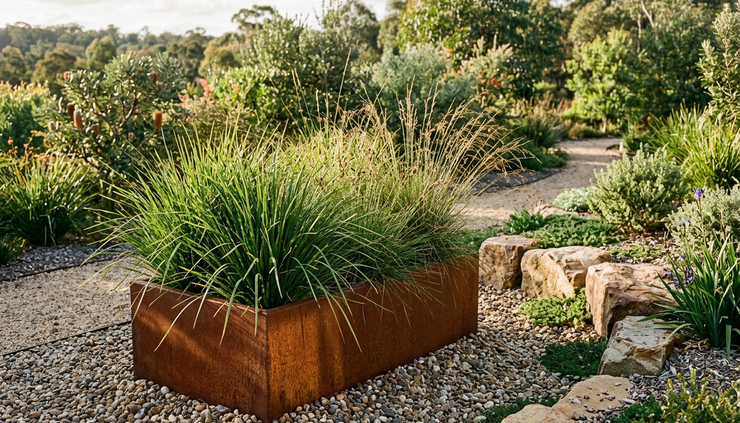
Still, when used safely, rust brings a depth that polished perfection often lacks. Rust softens hard lines. It settles into gardens. It pairs beautifully with native grasses, gravel, sandstone, concrete, recycled timber, and brick. It can look industrial, rural, coastal, or sculptural depending on the setting.
Plastic struggles here because its ageing process is different. Many plastics do not patinate in a graceful way. They fade, chalk, crack, warp, or become brittle. A white plastic chair left in the sun often looks tired rather than storied. A plastic pot can go from bright to dull without gaining much charm along the way.
Metal changes with drama. Plastic often just wears out.
The eye trusts imperfection
Perfect surfaces can feel impressive at first. A glossy plastic object might look sharp straight out of the shop. It is clean, smooth, and untouched. Yet that perfection can also make it feel temporary. The first scratch looks like damage. The first stain feels like failure.
Rusted metal starts from a different place. It already contains marks, and those marks are part of the appeal. A new scratch does not ruin it. A bit more weathering may make it better. That gives aged metal a forgiving quality that suits real life.
Think of a rusted steel fire pit. The oranges, browns, and blacks deepen after each use. Ash, heat, rain, and smoke add to its look. It belongs outdoors because it visibly responds to outdoor life.
Now picture a glossy plastic outdoor setting. The first scuff stands out. Sun fading makes the colour uneven. Dust clings to static surfaces. Instead of gaining depth, it often starts to look neglected.
This is one reason designers and makers often use aged metal to add warmth to modern spaces. A clean concrete courtyard can feel stark. Add a rusted planter, and the scene changes. The planter gives contrast, colour, texture, and age. It makes the space feel grounded.
Rusted metal
Changes through weather, touch, and use. Marks tend to add visual depth.
Rusted metal
Feels heavy, tactile, and specific to its place.
Rusted metal
Pairs naturally with timber, stone, soil, brick, and plants.
Brand new plastic
Starts clean and consistent. Marks often read as damage or wear.
Brand new plastic
Feels light, smooth, and easy to replace.
Brand new plastic
Can look harsh beside natural materials unless chosen carefully.
The eye does not need perfection to feel comfort. Often, it needs proof that something has been used, touched, and kept.
Patina connects an object to place
Materials gather meaning from where they sit. A rusted letterbox on a country road feels different from a rusted sculpture in a courtyard. The same surface can suggest age, utility, endurance, or art depending on its surroundings.
In Australia, rusted metal carries a strong visual link to sheds, water tanks, corrugated iron, railway yards, stockyards, old tools, coastal fences, and dry inland landscapes. It belongs to both rural and urban settings. You see it on laneways, garden edging, cafés, beach shacks, and restored warehouses.
That familiarity gives rust emotional weight. It does not feel imported from a catalogue. It feels connected to heat, rain, work, and weather. Even new weathering steel, when used well, can sit comfortably in a garden because it changes with the seasons.
Brand new plastic often has the opposite effect. It can look detached from its setting, especially when the colour is too bright or the finish too glossy. A plastic object may serve its purpose perfectly, but it rarely absorbs the spirit of a place. It resists its surroundings until the sun and weather overwhelm it.
Rusted metal, by contrast, is already in conversation with the world around it. Rain darkens it. Dryness lightens it. Plants lean against it. Soil stains it. Shadows catch in its uneven surface.
That responsiveness is part of its charm.
Plastic has uses, but it rarely gains soul
Plastic deserves a fair word. It can be light, waterproof, affordable, safe, and easy to clean. In many cases, it is the right material. Medical equipment, food storage, electrical insulation, toys, plumbing parts, and outdoor gear often rely on plastic for good reasons.
The issue is not that plastic is useless. The issue is that brand new plastic rarely has character.
Much of its value comes from sameness. It can be moulded into precise shapes at scale. It can be bright, flexible, transparent, or tough. These qualities are useful, but they do not usually create emotional attachment. If one mass-produced plastic stool breaks, another can replace it without changing much.
Rusted metal resists that kind of replacement. An old enamel sign, a dented toolbox, a worn gate latch, or a salvaged steel bench feels individual. The marks are tied to that particular object. You cannot order the exact same ageing pattern twice.
This is why people rescue old metal pieces from tips, farms, salvage yards, and demolition sites. A rusty wheel, a pressed tin panel, or a steel cabinet may have little financial value at first glance, but it has presence. Cleaned, sealed, repaired, or simply placed with care, it can anchor a room or garden.
There is also a sustainability angle, as long as it is handled honestly. Reusing old metal can reduce waste and preserve materials that still have life in them. Plastic can be recycled in some cases, but many plastic products are difficult to recycle in practice, especially when made from mixed materials or degraded by sun exposure.
Keeping a solid metal object in use often feels satisfying because it honours the material. You are not pretending age does not exist. You are letting age become part of the object’s value.
Patina works because it balances beauty and honesty
The best aged surfaces do not feel fake. That is why artificial rust effects can fall flat when they look too neat. Real patina has irregularity. It builds slowly. It has areas of intensity and areas of restraint. It follows gravity, use, and exposure.
A believable rusted surface often shows:
dark streaks where water has run
brighter orange where fresh oxidation appears
blackened patches from age or heat
polished spots where hands, tools, or fabric have rubbed
remnants of old paint or coating
rough and smooth areas sitting side by side
This is why rusted metal feels honest. It does not hide the fact that matter changes. It lets time show.
That honesty can make a room or outdoor area feel more human. Too many flawless materials can create a cold effect. They suggest maintenance, control, and replacement. A bit of patina interrupts that. It reminds us that things can be worn and still be beautiful.
Of course, the line between character and neglect is real. Rusted metal works best when it appears intentional, safe, and balanced. A single rusted panel in a neat garden can look sculptural. A dozen corroded objects piled without care can look forgotten. Context decides the result.
A few simple choices help:
Use rusted metal where strength is not compromised.
Keep sharp flakes away from hands, pets, and bare feet.
Seal pieces when staining is a problem.
Pair aged metal with clean shapes so it looks chosen, not dumped.
Let one or two patinated pieces stand out rather than crowding the space.
Character needs room to breathe.
Newness fades, but a good surface keeps unfolding
Brand new plastic offers the pleasure of the untouched. Rusted metal offers something slower. It rewards looking closely. The colour shifts through the day. The texture changes after rain. A surface that seemed plain from a distance reveals scratches, pits, drips, and layers up close.
That is the deeper reason rusted metal has more character than brand new plastic. It carries evidence. It shows age without apology. It turns wear into detail and weather into colour.
New plastic can be useful, cheerful, and sometimes beautiful. But it usually asks to be kept new. Rusted metal does not. It asks to be noticed as it is.
A patinated surface reminds us that objects become richer when they take part in life. The rust, the scratches, the dents, and the worn edges are not always flaws. Sometimes they are the very things that make an object worth keeping.


Comments